Back to Cheat Sheets
AI Architecture · Agent protocol comparison
Agent-to-Agent vs MCP
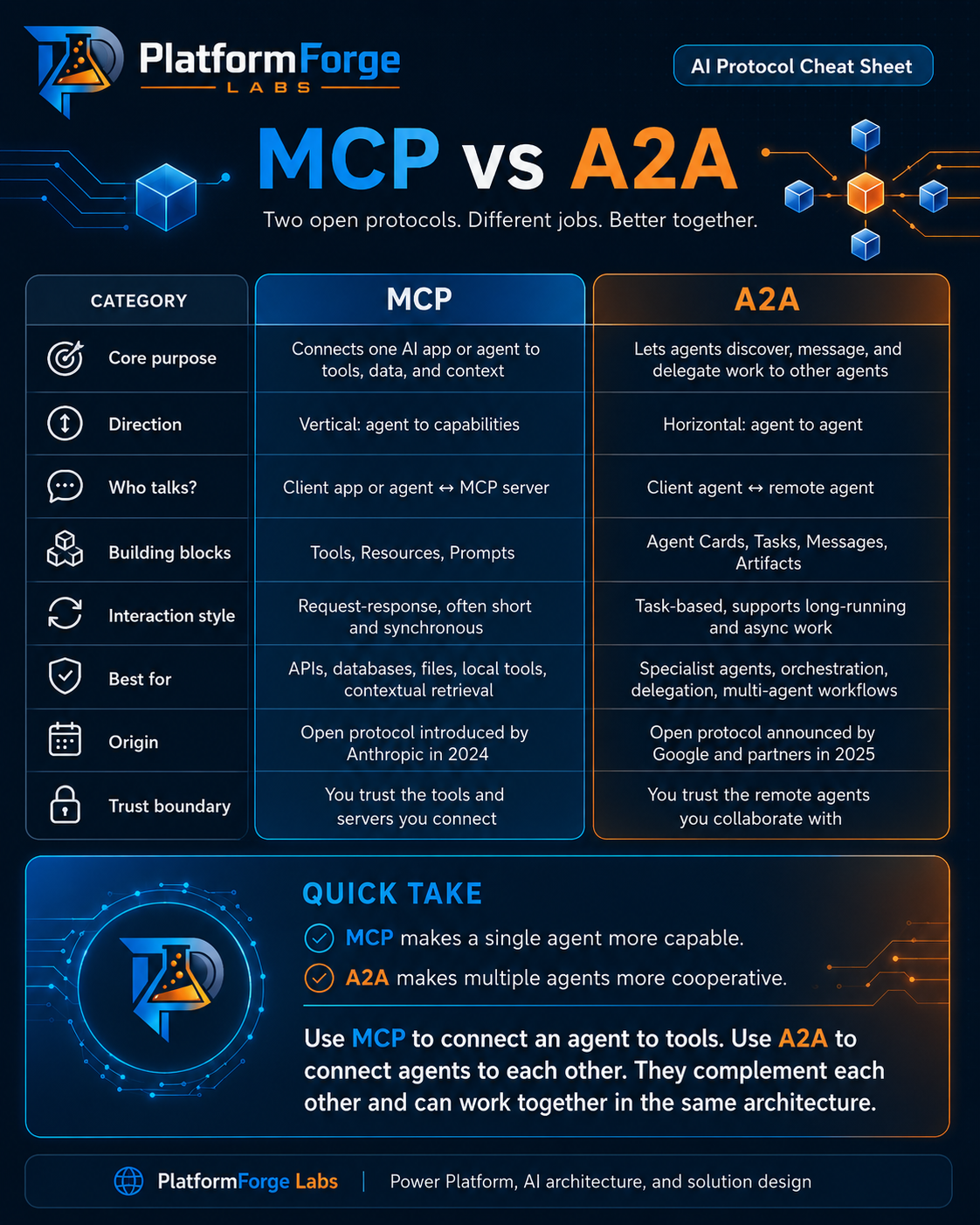
Use this when teams confuse MCP with agent-to-agent patterns. It positions MCP as the capability bridge and A2A as the collaboration bridge between remote agents.
Text version
Everything on the sheet above as text, so you can search it, copy from it or read it with a screen reader.
MCP vs A2A: two open protocols, different jobs, better together.
| Category | MCP (Model Context Protocol) | A2A (Agent2Agent) |
|---|---|---|
| Core purpose | Connects one AI app or agent to tools, data and context | Lets agents discover, message and delegate work to other agents |
| Direction | Vertical: agent to capabilities | Horizontal: agent to agent |
| Who talks? | Client app or agent ↔ MCP server | Client agent ↔ remote agent |
| Building blocks | Tools, resources, prompts | Agent Cards, tasks, messages, artifacts |
| Interaction style | Request-response, often short and synchronous | Task-based, supports long-running and async work |
| Best for | APIs, databases, files, local tools, contextual retrieval | Specialist agents, orchestration, delegation, multi-agent workflows |
| Origin | Open protocol introduced by Anthropic in 2024 | Open protocol announced by Google and partners in 2025 |
| Trust boundary | You trust the tools and servers you connect | You trust the remote agents you collaborate with |
Quick take
- MCP makes a single agent more capable.
- A2A makes multiple agents more cooperative.
Use MCP to connect an agent to tools. Use A2A to connect agents to each other. They complement each other and can work together in the same architecture.