Model Context Protocol Architecture
Use this when you need to explain MCP as the universal connection layer between AI applications and the systems, tools, data, and context they need.
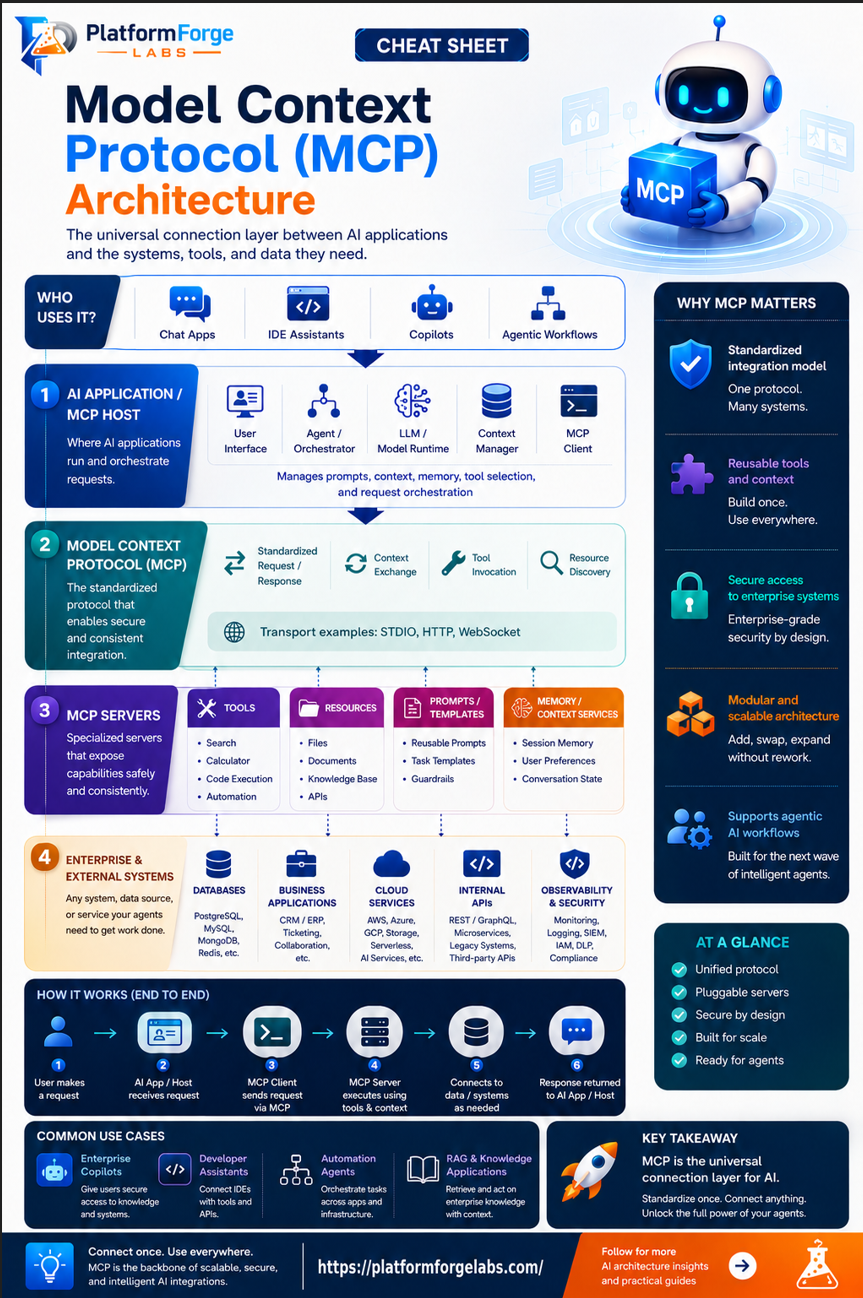
Text version
Everything on the sheet above as text, so you can search it, copy from it or read it with a screen reader.
MCP is the universal connection layer between AI applications and the systems, tools and data they need.
Who uses it: chat apps, IDE assistants, copilots and agentic workflows.
The four layers
| Layer | What it does | Parts |
|---|---|---|
| 1. AI application / MCP host | Where AI applications run and orchestrate requests. Manages prompts, context, memory, tool selection and request orchestration. | User interface, agent / orchestrator, LLM / model runtime, context manager, MCP client |
| 2. Model Context Protocol | The standardised protocol that enables secure and consistent integration. | Standardised request / response, context exchange, tool invocation, resource discovery. Transport examples: STDIO, HTTP, WebSocket |
| 3. MCP servers | Specialised servers that expose capabilities safely and consistently. | Tools, resources, prompts / templates, memory / context services |
| 4. Enterprise and external systems | Any system, data source or service your agents need to get work done. | Databases, business applications, cloud services, internal APIs, observability and security |
What MCP servers expose
- Tools: search, calculator, code execution, automation.
- Resources: files, documents, knowledge base, APIs.
- Prompts / templates: reusable prompts, task templates, guardrails.
- Memory / context services: session memory, user preferences, conversation state.
Enterprise and external systems
- Databases: PostgreSQL, MySQL, MongoDB, Redis.
- Business applications: CRM / ERP, ticketing, collaboration.
- Cloud services: AWS, Azure, GCP, storage, serverless, AI services.
- Internal APIs: REST / GraphQL, microservices, legacy systems, third-party APIs.
- Observability and security: monitoring, logging, SIEM, IAM, DLP, compliance.
How it works, end to end
- The user makes a request.
- The AI app / host receives the request.
- The MCP client sends the request via MCP.
- The MCP server executes it using tools and context.
- The server connects to data and systems as needed.
- The response is returned to the AI app / host.
Why MCP matters
- Standardised integration model: one protocol, many systems.
- Reusable tools and context: build once, use everywhere.
- Secure access to enterprise systems: enterprise-grade security by design.
- Modular and scalable architecture: add, swap and expand without rework.
- Supports agentic AI workflows: built for the next wave of intelligent agents.
At a glance: unified protocol, pluggable servers, secure by design, built for scale, ready for agents.
Common use cases
- Enterprise copilots: give users secure access to knowledge and systems.
- Developer assistants: connect IDEs with tools and APIs.
- Automation agents: orchestrate tasks across apps and infrastructure.
- RAG and knowledge applications: retrieve and act on enterprise knowledge with context.
Key takeaway
MCP is the universal connection layer for AI. Standardise once, connect anything, and unlock the full power of your agents. Connect once, use everywhere: MCP is the backbone of scalable, secure and intelligent AI integrations.